
How Dante is Transforming Residential Audio and What it Means for Integrators
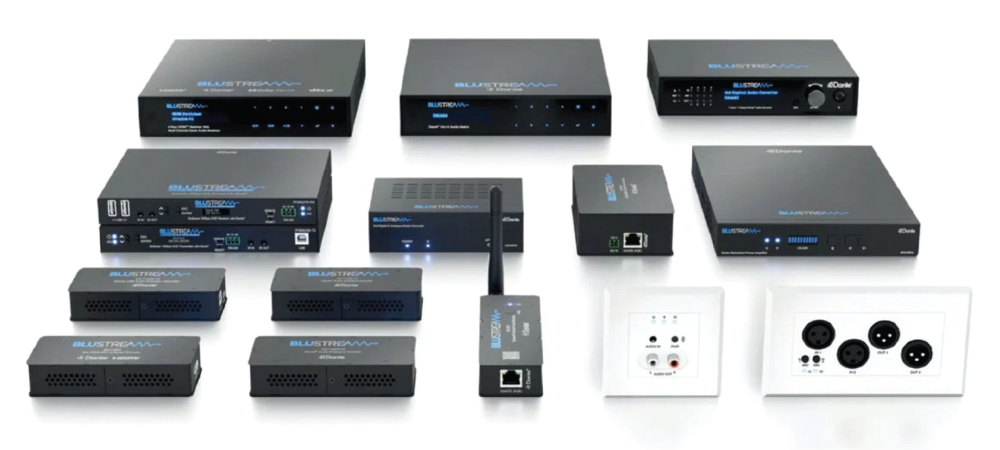
As homeowners continue to build out their audio systems, Dante offers residential integrators a flexible, scalable approach to audio distribution. Phil Davis, Managing Director, Blustream EMEA, examines how to take advantage of the technology while simplifying system design, installation and control.
Home audio is experiencing a renaissance. Homeowners are embracing a growing array of entertainment technologies, combining traditional favourites such as turntables and CD players with modern streaming devices, displays and increasingly sophisticated whole-home audio systems. For systems integrators, this evolution presents both an opportunity and a challenge: how to accommodate a diverse mix of audio sources while delivering the flexibility, performance and ease of use homeowners expect.
One of the most compelling answers lies in Dante, an audio networking platform that has already transformed professional and commercial AV installations and is now opening new possibilities in the residential market. Dante lets integrators move beyond the limitations of conventional distribution architectures, providing a flexible foundation for connecting, routing and managing audio throughout a property. More importantly, it enables us to design systems around the homeowner’s needs rather than the constraints of traditional infrastructure.
Offering New Options for Audio Distribution
Dante has long been established in the commercial AV industry, where its ability to transport multiple channels of high-quality digital audio over standard IP networks has made it a popular choice for applications ranging from corporate facilities to performance venues.
Its relevance to residential integration is becoming increasingly clear. With more than 4,600 Dante-enabled products available from 725 manufacturers, including Blustream, Sonance and Yamaha, integrators have access to a broad ecosystem of compatible technologies. At the same time, advances in residential networking infrastructure are making it easier to deploy sophisticated audio systems using readily available networking equipment.
Together, these developments are changing how integrators can approach residential audio design. Rather than relying exclusively on centralised distribution architectures, dealers can position equipment wherever it makes the most sense for the project, whether in a single rack, multiple locations or individual rooms.
My colleague Eric Randt, General Manager, Blustream U.S., offers this perspective, “To me, the biggest advantage of Dante is that it gives dealers options. If you want to build a traditional centralised audio system, great. If it makes more sense to put equipment in different locations, you can do that too. And if the project calls for a combination of both, Dante gives you that flexibility.”
Connecting Old and New
One of the most common misconceptions about Dante is that every device in the system must be Dante-enabled. That simply isn’t the case. In fact, one of the platform’s greatest strengths is its ability to bring traditional and networked audio technologies together through appropriate interfaces.
This is particularly advantageous to homeowners who don’t necessarily want to abandon their existing entertainment equipment when upgrading their audio systems. They may have a cherished turntable, an extensive CD collection, a Blu-ray player or familiar streaming devices such as Apple TV and Roku. These sources should remain part of the entertainment experience, even as the underlying distribution architecture evolves. By selecting the appropriate interfaces and understanding the requirements of each source, Dante enables a fully networked audio system of old and new.
Pro Audio Features in Smart Homes
With its roots in commercial AV, Dante opens the door to sophisticated audio applications that extend well beyond traditional whole-home entertainment. Residential integrators can leverage the platform to create professional-grade home recording studios, DJ-equipped entertainment spaces and other specialised environments that would be more complex to implement using conventional audio distribution methods. Dante’s support for the AES67 audio interoperability standard also expands integration possibilities for compatible unified communications (UC) systems, accommodating increasingly sophisticated work-from-home and hybrid work environments.
From an integrator’s perspective, this versatility provides a valuable opportunity to differentiate proposals by moving beyond conventional distributed audio systems with predetermined capabilities to deliver customised solutions that reflect each homeowner’s lifestyle and can be easily scaled to meet their evolving needs.
Tom Butler of residential integration company Butler Harrell has experienced these benefits first-hand. “For us, the real advantage of Dante is the flexibility it gives us when designing and installing whole-home audio systems. We’re no longer restricted by traditional centralised audio distribution, and we can easily integrate different sources, amplifiers and technologies across a property,” Tom explains. “Blustream has made Dante much more accessible for residential projects, with products that simplify the integration of both traditional audio sources and networked audio.”
Uniting Advanced Audio Networking with Familiar Controls
For integrators who haven’t previously worked with Dante, the prospect of introducing a professional audio networking platform into a residential installation may seem daunting. However, the technology doesn’t need to fundamentally change the way integrators approach the homeowner experience.
The important distinction is between commissioning the audio network and controlling the system during everyday use. Dante Controller, a free software application, allows integrators to establish audio subscriptions between devices, configure the network and access information about clocking, latency and other parameters useful during installation and troubleshooting.
Once the system has been commissioned, those configurations are stored within the Dante devices. A computer running Dante Controller isn’t required for normal operation of the commissioned hardware system.
This separation is significant because it allows the underlying audio infrastructure to remain sophisticated without exposing that complexity to the homeowner. Integrators can take advantage of Dante’s routing and networking capabilities while delivering the familiar control experience customers expect.
Exposing New Opportunities for Residential Integrators
Dante is more than another audio distribution technology. It represents a shift in how we can approach residential system design, giving integrators greater freedom to combine technologies, accommodate specialised applications and respond to changing homeowner expectations. But the most successful implementations won’t necessarily be those with the most sophisticated network architecture or the greatest number of connected devices.
They’ll be the systems that use those capabilities to make the homeowner’s experience simpler, more reliable and more enjoyable. Ultimately, homeowners shouldn’t need to know whether their music is being transported over Dante, through a conventional audio matrix or via another distribution technology. They simply want to choose what to listen to, decide where to hear it and enjoy the experience without complication.
By combining Dante’s flexibility with thoughtful system design, appropriate interfaces and intuitive control, residential integrators can deliver audio experiences that satisfy today’s expectations while providing a foundation for whatever comes next.